


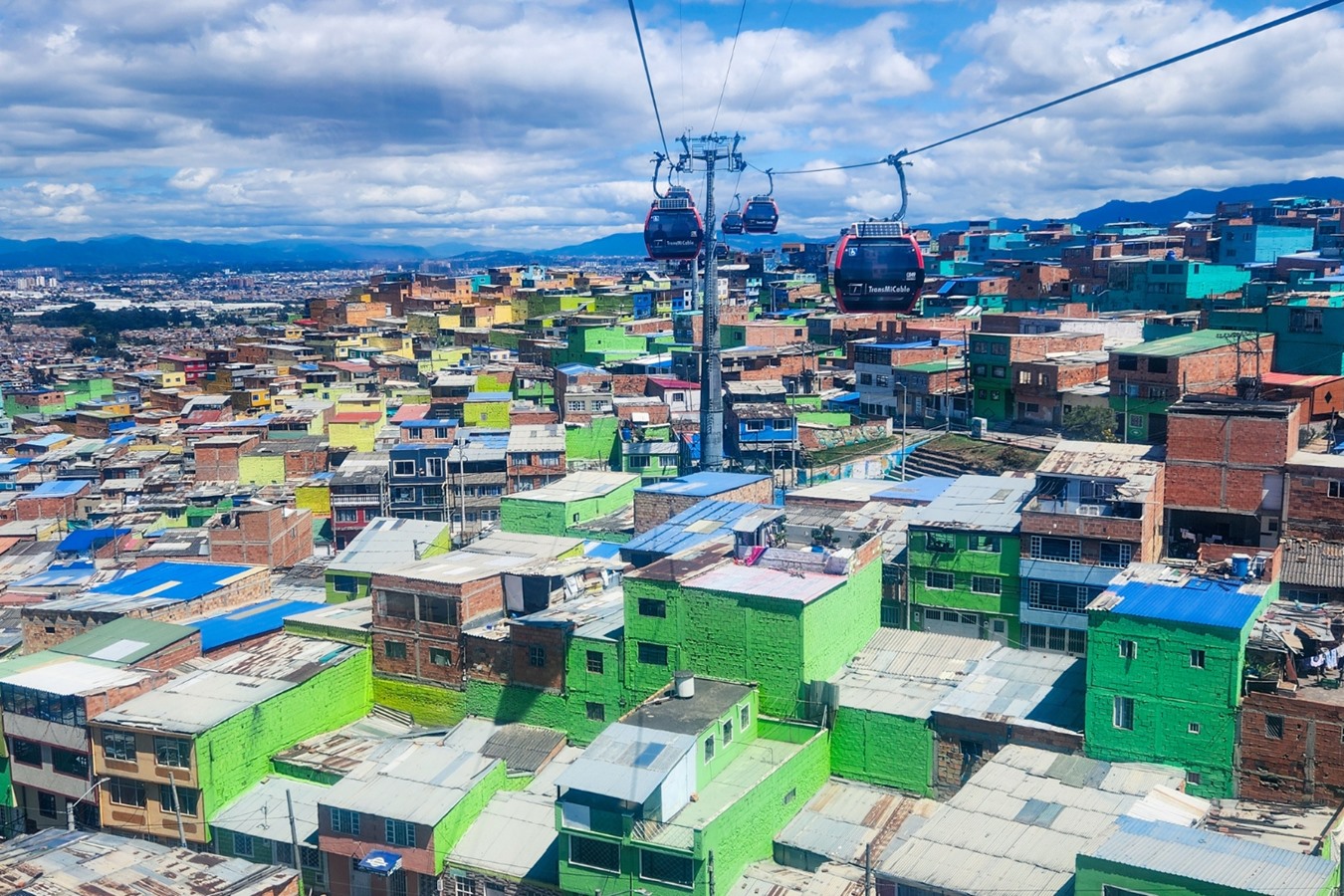
Want to see more than the standard tour of Bogotá? Then visit the colorful neighborhood of El Paraíso. In the very south of the city, there’s a cable car that takes you up the mountain. From there, you have the most beautiful view of Bogotá (even better than from Monserrate), you’ll find impressive street art, and you’ll fly over the colorful neighborhoods by cable car. It’s far off the beaten path, but then you’ll (literally) discover the other side of Bogotá. Here you can read everything about visiting El Paraíso. Including how to get there, of course.


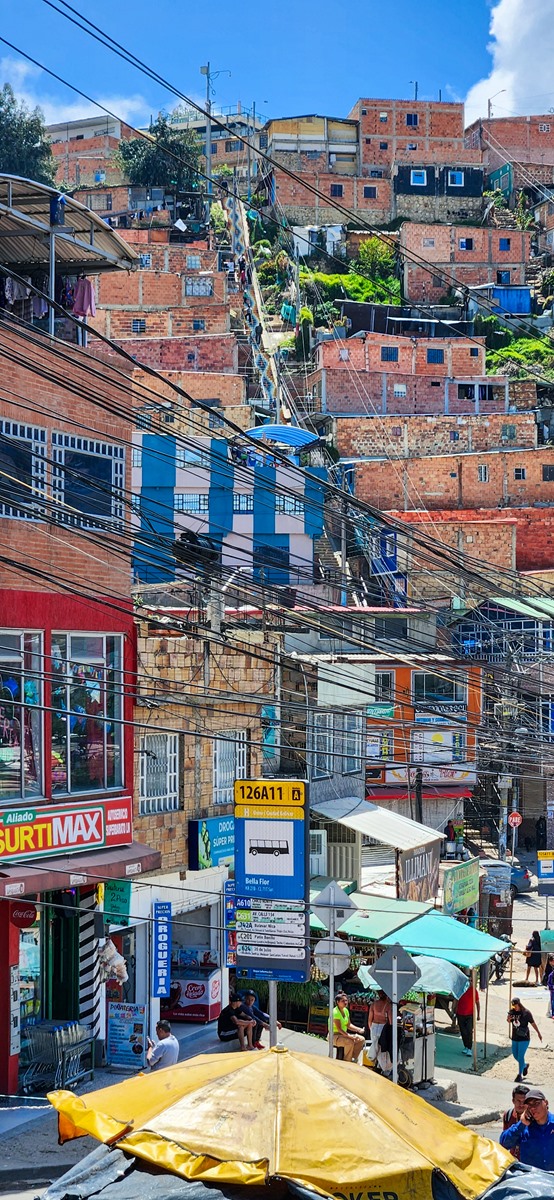
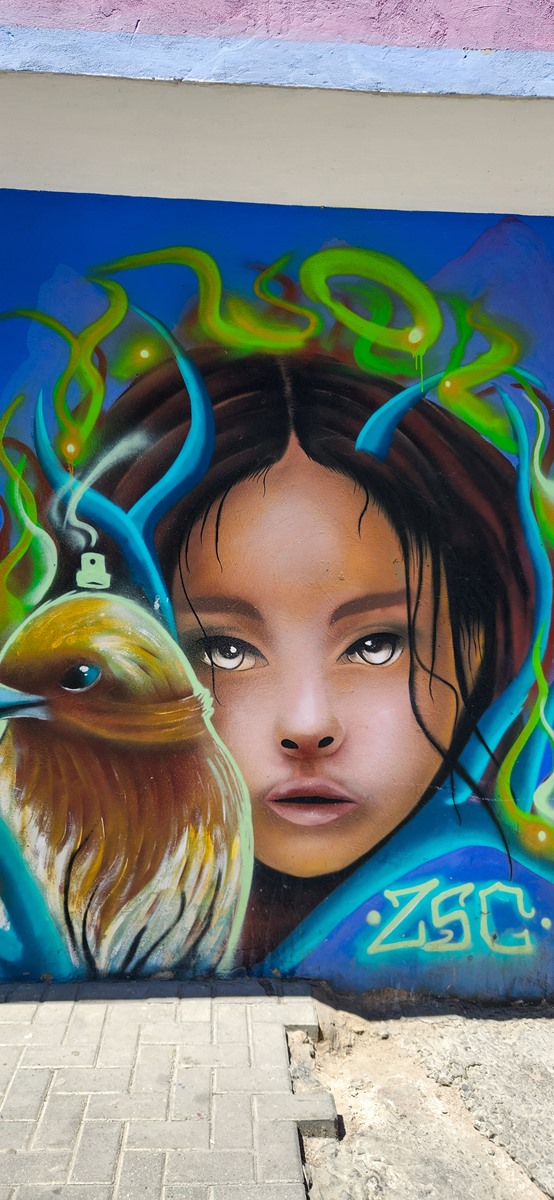
Table of contents
The colorful neighborhood of Ciudad Bolívar in Bogotá
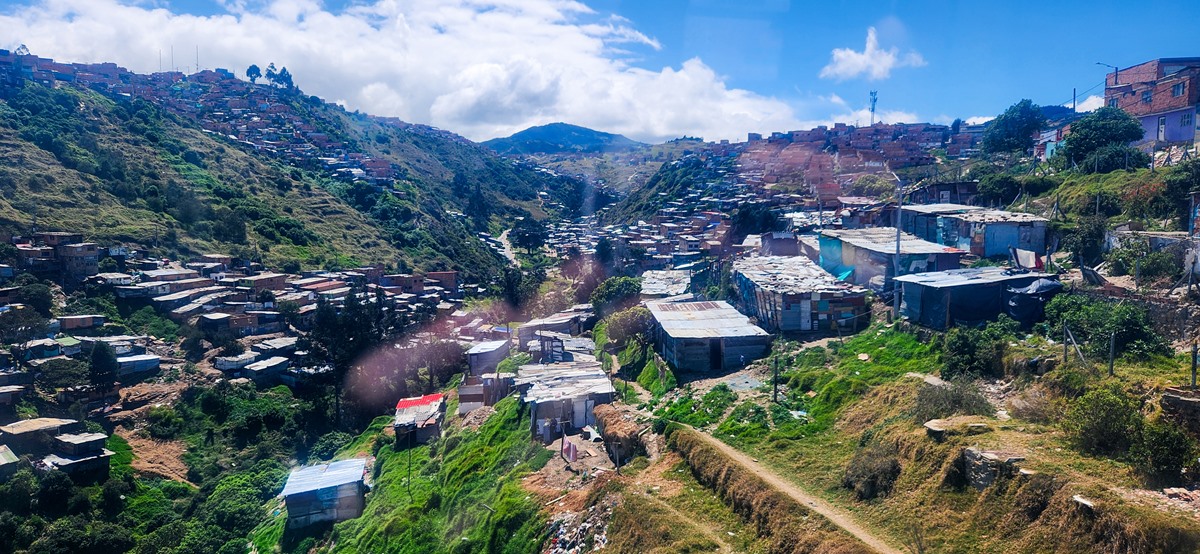
Ciudad Bolívar is a mountainous district in the south of Bogotá, located at an altitude of approximately 2800 meters (9186 feet). For most Bogotanos, this is a part of their city that they would rather not visit. Even my boyfriend didn’t want to come with me, because ‘there is nothing to do’, ‘it is dangerous’ and ‘there is a lot of poverty’.
And yes, that is partly true. But Ciudad Bolívar has not been standing still and is developing positively. There is also quite a special story attached to this neighborhood. It started in the 1940s, when more and more people gradually started living on the steep slopes. A large part of their houses are built by the residents themselves. Quite special. In the Museo de la Ciudad Autoconstruida you will learn everything about how the district originated.
Ciudad Bolívar consists of approximately 300 to 350 neighborhoods, of which El Paraíso is one. It has an area of approximately 130 km² and has about 800,000 inhabitants. Although various sources give different population numbers, this is the average.
Although the largest part of Ciudad Bolívar consists of estratos 1 and 2 and approximately 37% of the inhabitants live in moderate to extreme poverty (source, 2023), much has improved in recent years.


The development of Ciudad Bolívar
In addition to the fact that NGOs have been active in the neighborhood for years, the population itself also revolted in October 1993. A major civil uprising, called Paro Cívico, in which residents blocked main roads for 13 hours to force the city government to find concrete solutions to the problems in their district. They wanted attention for basic facilities and living conditions. And they succeeded.
A wave of cultural and social initiatives was launched, such as libraries, youth and education initiatives and cultural working groups. From the 2000s, the result of this became increasingly visible: small festivals were organized and in local media Ciudad Bolívar was no longer only portrayed as a problem neighborhood, but as a place with creativity and pride. Local guides, street art routes and workshops emerged.
And then, in 2018, came the TransMiCable. The cable car not only made the neighborhoods in Ciudad Bolívar more accessible, but suddenly the new developments were given a larger stage. The southern neighborhoods that Bogotanos used to ignore became accessible to everyone. And although there are still many problems, including with safety, the positive changes are clearly visible.
With one of the best examples being the colorful neighborhood of El Paraíso, the pride of Ciudad Bolívar. Which you can now visit.


The TransMiCable: the cable car in Bogotá
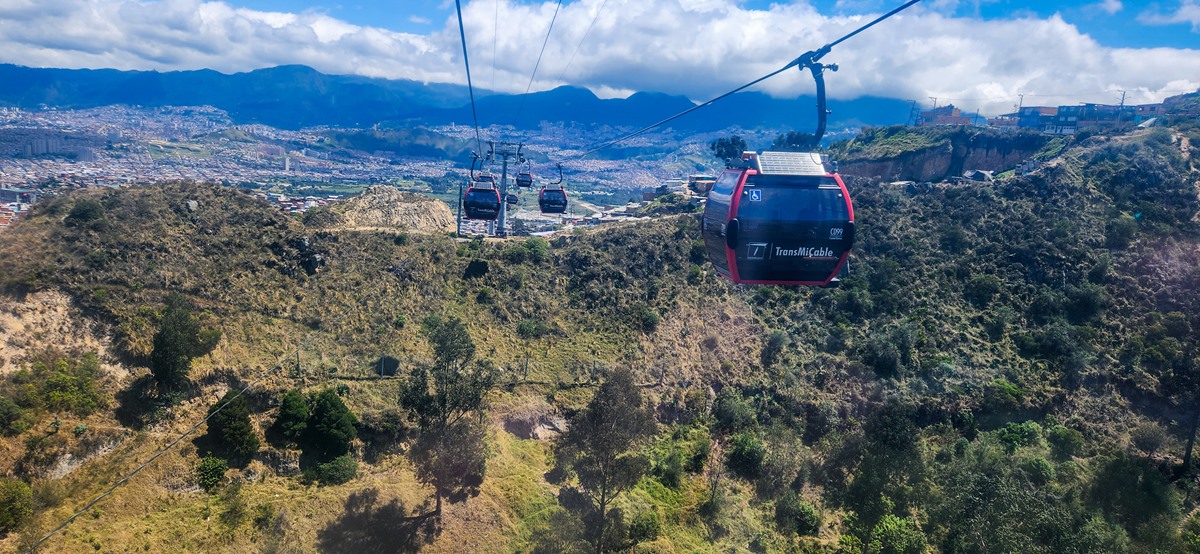
The TransMiCable was opened in December 2018. A new and important part of the Transmilenio transport system in Bogotá, those long red buses that you see driving through the city.
The TransMiCable cable car is not a cable car for tourists, but a public transport connection that connects the steep neighborhoods with the rest of Bogotá. The cable car’s goal was therefore to increase mobility and drastically reduce travel time for residents. Residents now gratefully use this cable car to get to their work, school or other places 45 minutes faster. They are therefore literally more connected to the rest of Bogotá. On the other hand, more visitors are now coming up the mountain, which benefits the local economy and development.
And then we have the cultural side. The Mirador del Paraíso station is not just an ordinary station, but is increasingly becoming a cultural place, with new neighborhood initiatives, street art and of course that amazing view over Bogotá. But more on that later.
It is great fun to go up with the cable car and admire the colorful houses of the neighborhood from above. Highly recommended if you are in Bogotá!


Fun facts about the TransMiCable
The TransMiCable consists of 163 cabins, each of which can accommodate 10 passengers. The journey time from the start to the end station is approximately 15 minutes on weekdays and 20 minutes on weekends (then the cable car runs slightly slower). As a result, 3600 passengers per hour can be transported per direction. You travel approximately 3.3 kilometers (about 2 miles) during the ride.
There are 4 stations: Tunal, Juan Pablo II, Manitas and Mirador del Paraíso. The latter is where you get off when you visit this neighborhood.
Safety is a high priority. There are cameras, an intercom and an emergency button to quickly contact staff. The stations and cabins also look very nice and luxurious. It felt safe inside, and I really don’t like heights and cable cars at all.

What is there to see in El Paraíso in Bogotá? | A neighborhood with a story
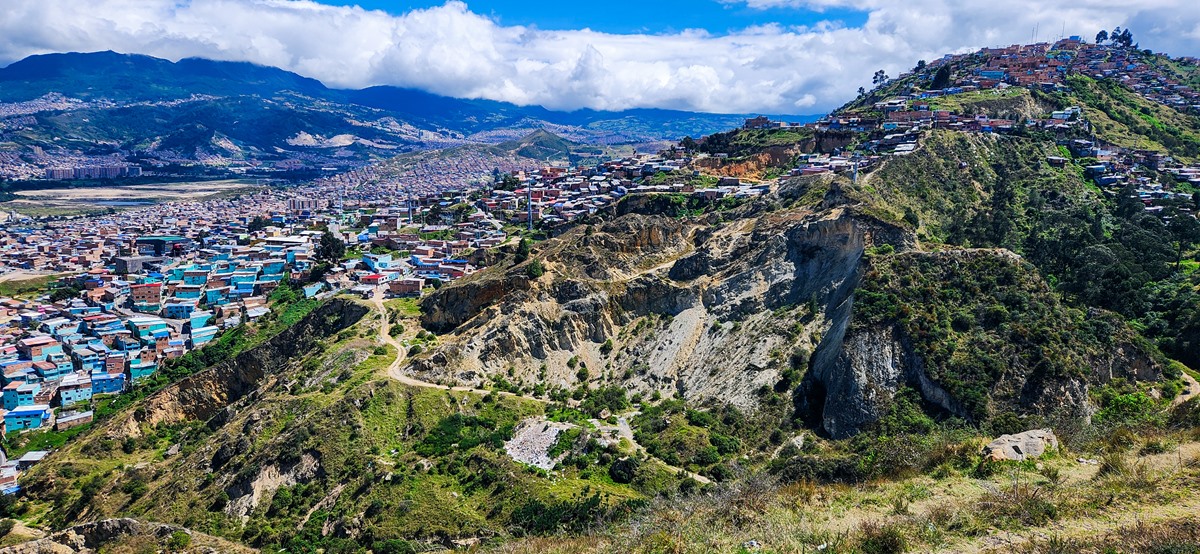
As soon as you step out of the cable car at the top of the mountain, you walk into the interesting neighborhood of El Paraíso. Located within the Ciudad Bolívar district, on a cliff, the neighborhood has approximately 12,000 inhabitants. The station of the cable car is not called ‘Mirador del Paraíso’ for nothing: from here you have the most beautiful view over Bogotá.
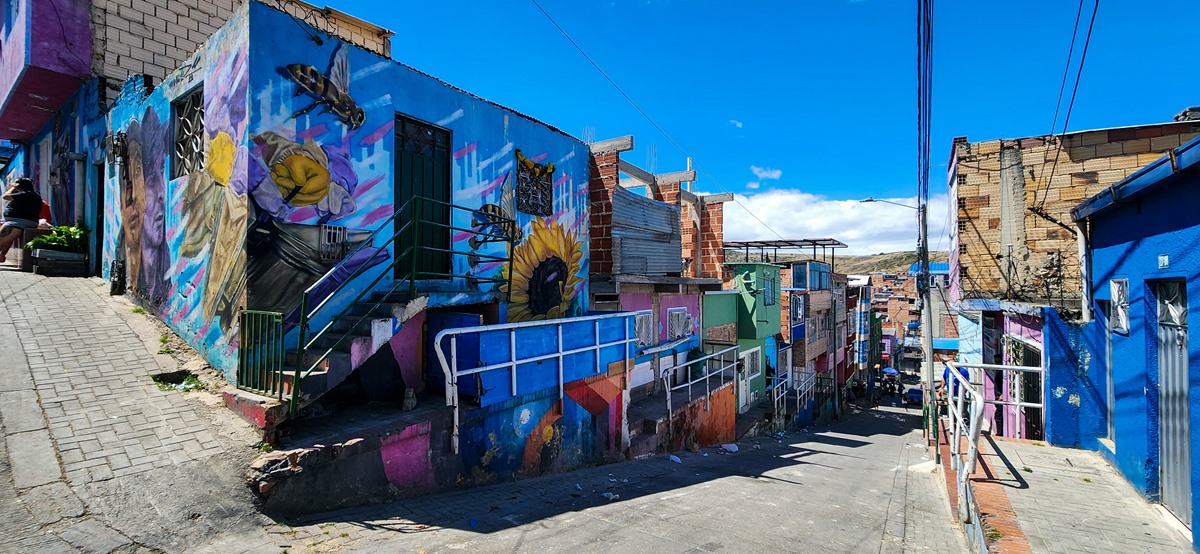
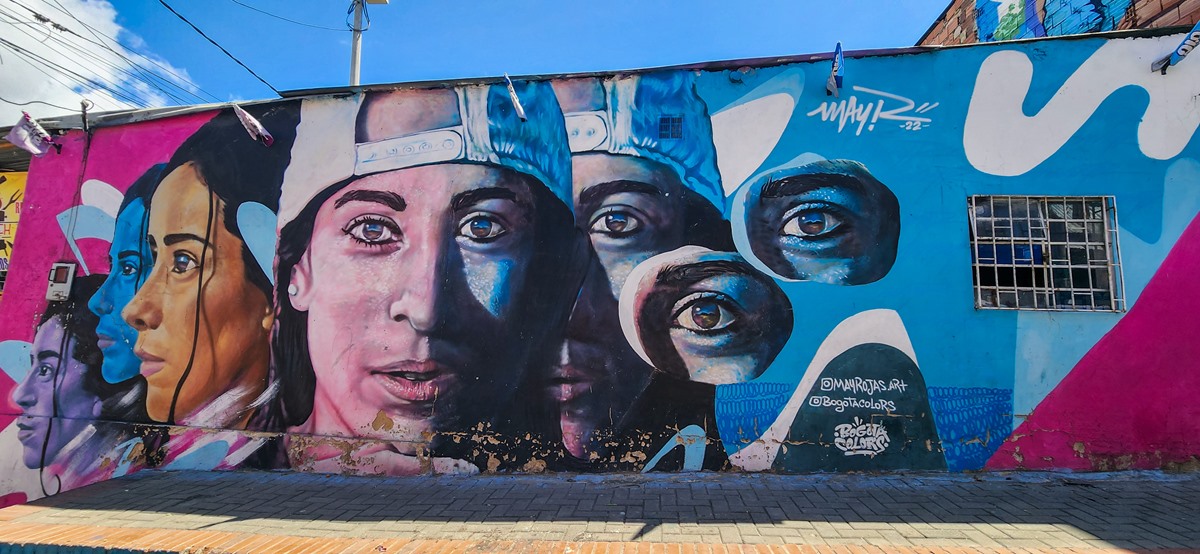
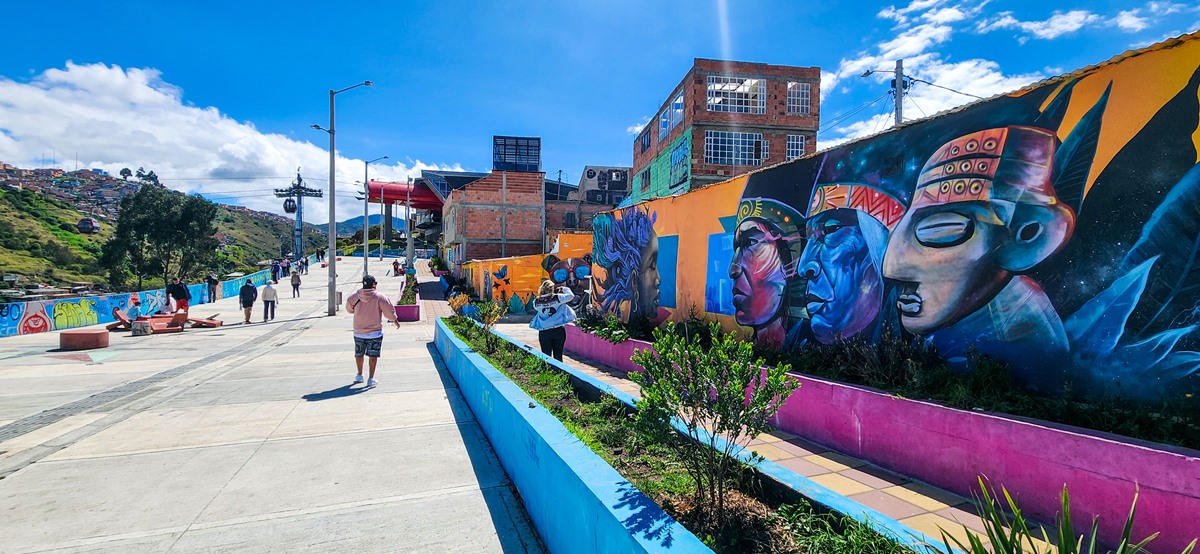
But there is more. Since 2015, El Paraíso has been transformed into a kind of open-air museum of murals. You will find walls full of colorful street art that radiate their own identity and pride.
One of the faces behind that movement is Michael Esteban Rojas, better known as May. He does not see graffiti as ‘something on a wall’, but as a way that can bring people together and at the same time make the neighborhood more beautiful, stronger and more visible. Under the leadership of Luisa Sabogal and May Rojas, the collective Bogotá Colors was founded in 2015. Through art and culture, they want to break with stigmas and help change the lives of all residents.
As May himself beautifully summarizes it: every mural must have an impact, tell a story that people can directly or indirectly benefit from. Art as a calling card, but above all: art as a driver of change.


El Paraíso: where every wall tells a story
Thanks to this initiative, El Paraíso has been transformed into a colorful open-air gallery, where every wall tells a story. Both national and international artists have changed the dynamics of daily life in this part of Ciudad Bolívar with their murals.
Via tourist routes, such as La Calle del Color, you as a traveler are taken through the neighborhood. So that you not only see the murals, but also learn the story behind each mural.
Today, there are a number of organizations that offer tours through El Paraíso in Bogotá. These organizations bring together street art, social projects and cultural tourism. I myself did the tour with Autenticos Travel.




How do you visit El Paraíso in Bogotá?
A visit to Ciudad Bolívar and specifically the El Paraíso neighborhood is a lot of fun. Highly recommended if you want to see more of Bogotá than the standard sights.
Just going up with the cable car is a great experience. You can enjoy the beautiful views and the colorful houses of the neighborhood for 20 minutes. Don’t forget to look around you: you will find an eye in the rocks. See if you can discover the eye in one of the photos in this article…
With a guide to El Paraíso
I visited the neighborhood with the tour Bogotá’s Barrios: El Paraíso Favela Tour by Cable Car. Highly recommended. You go with a very nice guide who speaks good English and knows everything about the neighborhood, into the neighborhood. In addition to the guide, there is also a security guard, after all, you are in a very safe neighborhood of Bogotá. The tour leads you through the streets of El Paraíso. Including the Calle de Color. And he tells a lot of information and stories about the neighborhood.
You walk past the most beautiful murals, you get a local snack and the tour ends at the Parque Mirador Illimani. From there you walk over the beautiful boulevard with impressive murals on one side and an even more impressive view of the city on the other. You run out of eyes… It is so beautiful there that the short walk back to the cable car takes half an hour. You just keep taking photos and looking around.
The tour lasts about 5 hours. You will be picked up from your hotel and neatly taken back. I thought it was very well organized and punctual.
Book the tour to El Paraíso by cable car here.

Can you also go to El Paraíso alone?
During the day you could take the cable car to Mirador del Paraíso alone and walk along the boulevard with street art. Especially on Sundays, when there are more Bogota visitors. Going into the neighborhood without a guide is not recommended. That is not safe and you will also miss a lot of information about this neighborhood. Because although it is safer than 10 years ago, that does not mean that it is now safe enough. Also, don’t expect lots of tourists: they are not here. Even on a Sunday with beautiful weather, it is quiet. I haven’t seen any foreigners (except those within our group of course). This is really still a neighborhood in development.
How do you buy a ticket for the TransMiCable cable car?
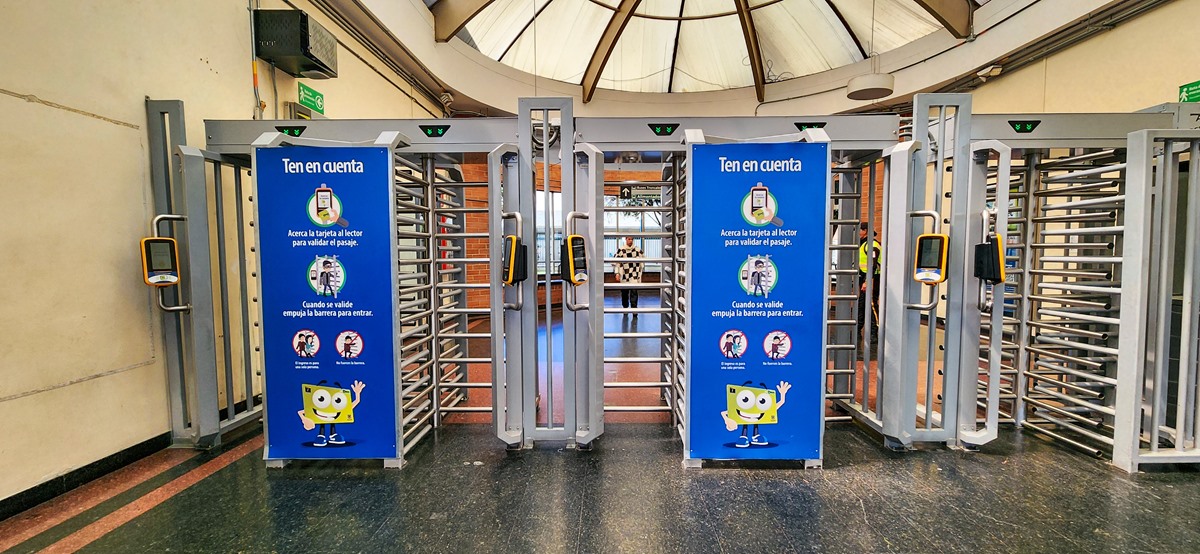
If you want to take the cable car without a tour, you have to take care of a ticket yourself. In Bogotá you pay for the Transmilenio and the TransMiCable with the same system: a public transport chip card called TuLlave. You can buy a TuLlave card at any large Transmilenio station in Bogotá. If you only want to take the cable car, you can easily buy a ticket in the station Portal del Tunal, where the cable car starts.
If you buy a ticket, you can immediately put money on it, 10,000 pesos for example. You check in with the ticket, you don’t have to check out. You can use one card for several people, but make sure there is enough money on it. One ride costs 3,350 COP (2026) per person. You therefore need 8000 pesos for a return trip for one person.
Things to consider when visiting the neighborhood
- Ciudad Bolívar is located in the very south of the city. There is a lot of traffic in Bogotá, and it may take you a long time to get there. I was lucky, because it was sunny and I went on a Sunday when many people were still on vacation. It took me 30 minutes from La Candelaria. However, if you are staying more to the north in Bogotá, it is raining or it is simply a very busy day, take into account a travel time that can take up to more than an hour.
- Don’t just wander around alone, you are in a poor neighborhood where tourism is only just taking off. Do you want to go into the neighborhood yourself? Then book a tour.
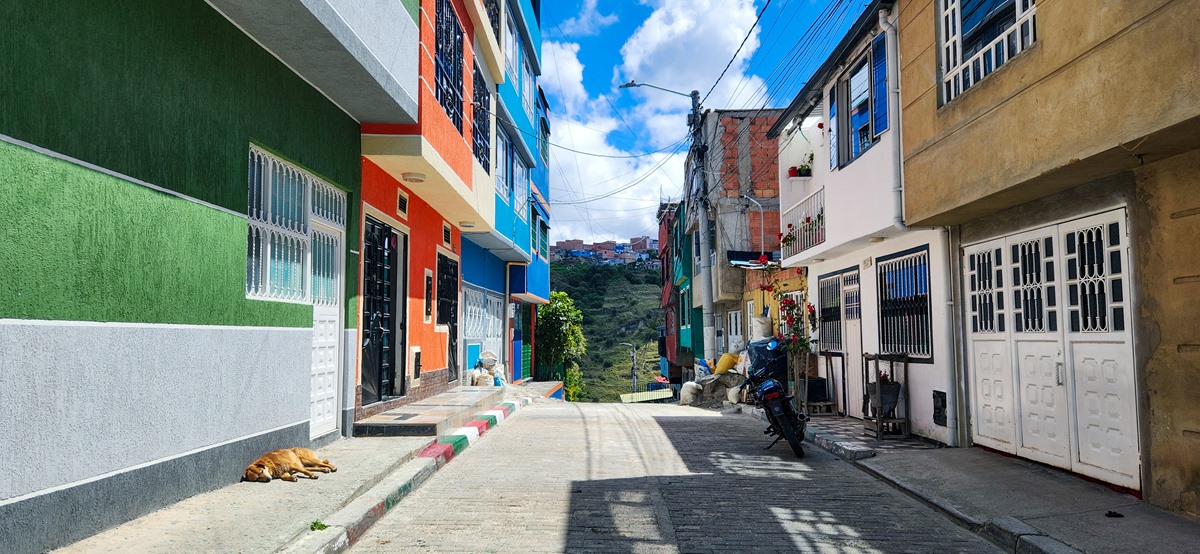
- There are a lot of stray dogs, I have never seen as many stray dogs anywhere in Bogotá as in Ciudad Bolívar. They shouldn’t do anything, but if you are afraid of dogs, this is good to know.
- There is also a lot of waste, everywhere on the street. However, that does not mean that you should add even more waste yourself. Take bottles and plastic back down and throw them in the trash.
- Don’t go after sunset.
- There are free toilets at the cable car stations, which are also quite clean. There is only no toilet paper, so it doesn’t hurt to bring some paper yourself.
- Take protection against the sun, you are high in the mountains. Sunscreen, a cap and sunglasses are not an unnecessary luxury. A bottle of water is also useful.
- Leave everything you don’t need in your hotel or AirBnB. So leave your jewelry at home and make sure you don’t flaunt anything. Don’t give papaya as we call it in Colombia.
- Do you want to buy something? In most places in El Paraíso you can only pay in cash. Therefore, take some cash with you in case you want to buy something small. A snack and a drink are included in the tour.
- No English is spoken in this neighborhood. If you want to communicate with the local population, Spanish is the only way. This guide speaks very good English.
Useful links & locations for your visit
Where exactly are Ciudad Bolívar and El Paraíso located in Bogotá? Where can you find the station to board the cable car? What other interesting spots are there?
- You can find Ciudad Bolívar here on the map.
- Here Station Mirador del Paraíso, and the El Paraíso neighborhood.
- Station El Tunal where you board the TransMiCable and buy your ticket.
- Here you will find the letters of Bogotá, in case you want to take a photo with them.
- The boulevard with the view and street art is called Paseo Alameda Illimaní, you will find it when you walk out of the TransMiCable directly to the right down.
- Museo café el rincón del paraíso: a small neighborhood museum and café, with a collection of typewriters, old photos, newspapers, coins and banknotes, comics, radios, toys, musical instruments, pans, lamps and all kinds of other items from daily life. Only go here with a tour, you have to go through the neighborhood for it.
- Museo de la Ciudad Autoconstruida.
- Book your tour through El Paraíso here.


Venture into the interesting Bogotá and discover a different, still unknown, side of the city. A great experience!
In this article, the links to the tour are affiliate links. If you click on one of these links and book the tour, I will receive a small commission. The price remains the same for you. This helps me to create new content and maintain my website. I paid for the tour I mention in this article myself, so this is not a collaboration with the tour operator.

1 comment
It is so nice to read about Bogotá and especially el paraiso. I m considering a 3 day trip in December from Santo Domingo (we are going on a package trip and staying for 10 days, which I think might be a bit boring with only sand and beach and a few excursions).
Do you have any recommendations for a mid range place to stay for a solo traveller for 3 nights in Bogotá?